
You may be reading this with a baby on your lap, or with a toddler who was a newborn not so long ago. Either way, you want to feel like yourself in your body again, and you do not have an hour to spare. This guide to postpartum fitness for beginners is built for that kind of day: a few minutes at a time, no scale, and no deadline.
Why you don’t need to “bounce back” (and what to aim for instead)
Your body did something huge. Pregnancy, birth and the weeks after change your muscles, your joints, your sleep and your hormones. Expecting to snap back to an earlier version of yourself on a schedule gives you a goal your body was never going to meet, and then a reason to feel bad about it.
A better set of goals is one you can feel from the inside:
- Energy: Do you get through the afternoon with a little more in the tank?
- Mood: Do you feel calmer or lighter after you move, even a bit?
- Strength: Is carrying the car seat, the laundry basket or the baby getting easier?
Those three things are worth tracking, and none of them requires a scale or a mirror. Your plan in this guide has no weight goal. If you ever want one, that is a separate decision for another season.
Before you move: what to ask your doctor or midwife
Start with a conversation. Every birth and recovery is different, and your doctor or midwife knows yours. Many providers schedule a postpartum check-up in the first weeks after birth, but timing varies. If you are months out and never really talked about exercise, you can still bring it up now.
Here are questions worth asking:
- When is it okay for me to start walking and light exercise, given how my birth went?
- Did I have a cesarean, tearing or any complications that change what I should avoid?
- Can you check for diastasis recti (abdominal separation) and tell me what to avoid if I have it?
- Would a pelvic floor physical therapist be a good idea for me?
- If I’m breastfeeding, is there anything I should know about eating and drinking more as I get active?
Also ask which symptoms mean you should stop and call. Heavy bleeding, sharp pain, a feeling of pressure or heaviness in your pelvis, or leaking when you move are all worth mentioning to your provider rather than pushing through. Write the answers in your phone so you are not relying on a sleep-deprived memory.
Redefine a workout: 5 minutes still counts
When you picture a workout, you might see a gym, a 45-minute class or a full outfit change. That picture is the main reason many new moms never start. It does not fit into a day built around feedings and naps.
Try a different definition: a workout is any planned stretch of movement that you do on purpose, however short. Five minutes counts. So does two.
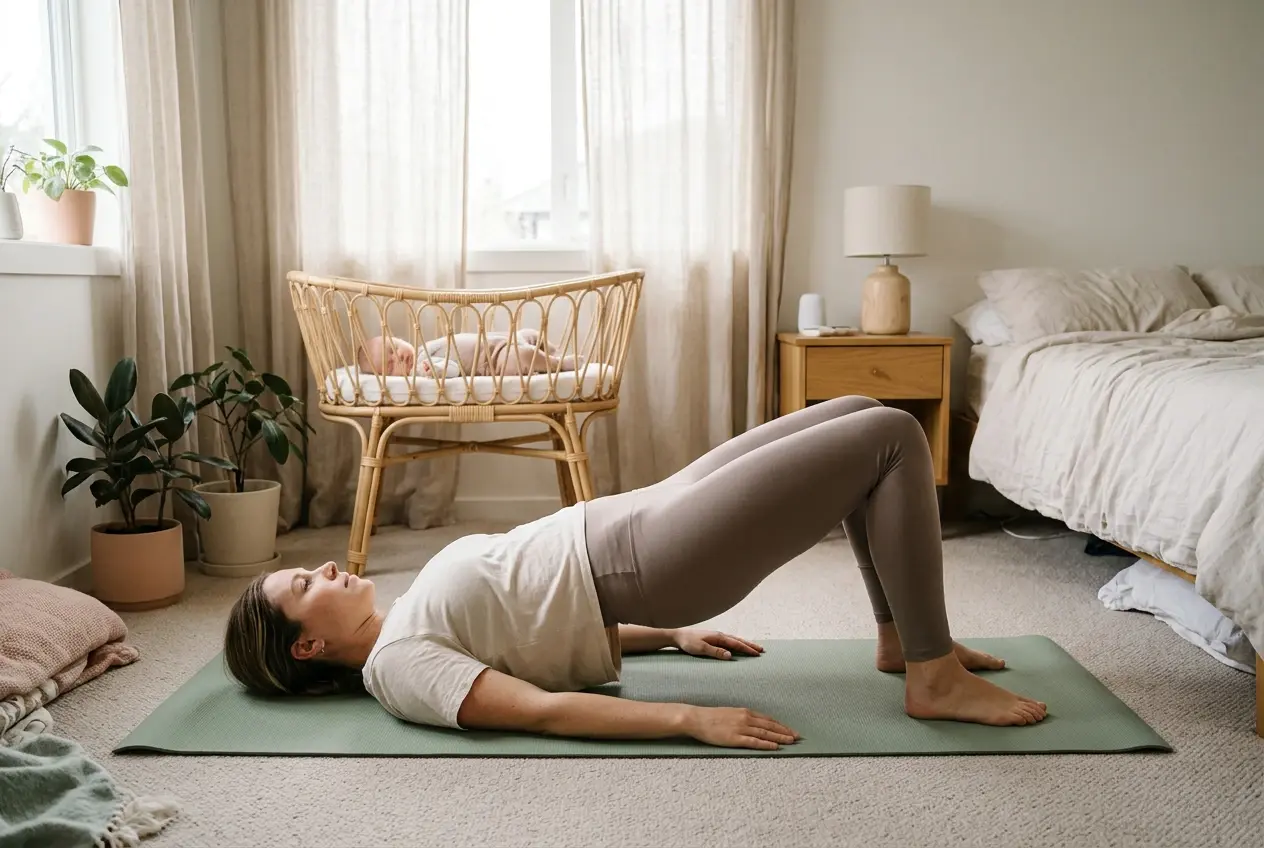
Short sessions have practical advantages right now. You can do them in pajamas. You can do them while the baby is on a play mat next to you. And because they are small, you are far more likely to do them again tomorrow, which matters more than how long any one session is.

Think of the first few weeks as building a habit of showing up. Intensity can wait.
A gentle first month: breathing, walking and light strength, week by week
This is a sample, not a prescription. If your provider gave you different guidance, follow theirs. Go slower any time something feels off, and repeat a week as many times as you like.
Week 1: breathing and a short walk
Begin with deep belly breathing. Sit or lie down, put a hand on your ribs, and breathe in through your nose so your ribs and belly expand gently. Breathe out slowly through your mouth. Do this for one to two minutes. It is a calm reset and a good way to reconnect with your core and pelvic floor.
Then add a slow walk of five minutes, around the house, up and down the driveway, or to the end of the block. Stop sooner if you feel tired. Skip a day if you need to.
Week 2: longer walks, a little more often
Stretch your walks to 8 or 10 minutes if that feels good, and aim for a few days this week. A stroller walk counts, and so does carrying the baby around the yard in the sunshine. Notice how you feel afterward, because that feeling is your progress report.
If your shoulders and back feel tight from feeding and carrying, you could add a few gentle stretches. The 10-minute stretching routine for busy moms is a good place to borrow from. Pick two or three moves rather than doing the whole thing.
Week 3: add light strength
If your provider has cleared you, add a few simple moves with just your body weight. Here are a few to try:

- Sit-to-stand: Lower onto a chair, then stand up slowly. Try 8 reps.
- Glute bridge: Lie on your back with knees bent, and lift your hips a few inches. Try 8 reps.
- Wall push-up: Stand an arm’s length from a wall and lean in. Try 8 reps.
Do one round, rest, and stop there if that is all you have. Breathe out on the effort, which is the standing up, lifting or pushing part, and do not hold your breath.
Week 4: put it together
Walk on most days, and do your light strength moves two or three times this week. Keep each session short. If you feel ready, you can lengthen a walk or add a second round of strength moves. If you feel wiped out, repeat week 3. Nothing is behind schedule.
Fit it around naps, feedings and chaos: real-life scheduling ideas
You will not find a free hour, so build movement into moments that already exist. Pick one or two of these and ignore the rest.
- Pair it with something you already do. Breathe for a minute while the bottle warms or the coffee brews. Do your bridges right after the baby goes down for a nap, before you reach for your phone.
- Move with the baby. A walk with the stroller or carrier takes care of fresh air and movement together. Floor time on a play mat is a good moment for stretches or bridges while the baby watches.
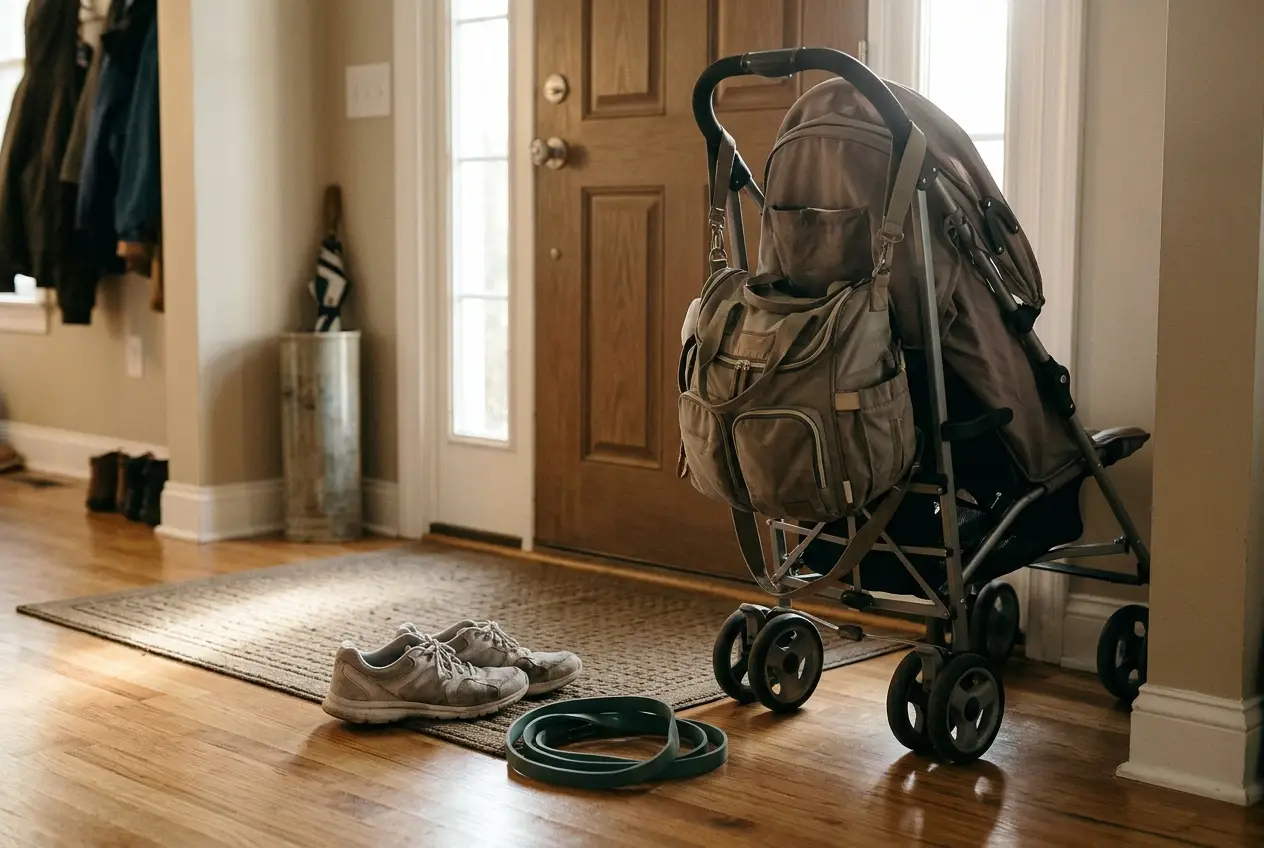
- Keep it visible. Leave a resistance band or your sneakers by the door, so you do not have to find them when you finally get a minute.
- Choose the easiest time, not the ideal time. The best time to move is whenever you actually have the energy. For one mom that is the morning, and for another it is after the evening bedtime routine.
- Split it up. Three 5-minute walks are as good a start as one 15-minute walk.
If your partner, a relative or a friend offers help, a specific request works better than a vague yes. Ask them to hold the baby for ten minutes while you walk.
Once your routine feels steady, the realistic weekly wellness routine for busy moms shows how to spread movement, rest and small habits across the whole week.
Eat to feel steady, not to shrink: simple meal planning for the tired weeks
Food in these weeks has a job: keeping your energy and mood level so you can get through the day. It does not need to shrink anything. Cutting calories hard while you are recovering and short on sleep tends to make you feel worse, and if you are nursing, your needs may be higher. Your doctor or midwife can tell you what is right for you.
Aim for meals you can put together with one hand:
- Include protein at most meals. Eggs, Greek yogurt, beans, chicken, tuna, cheese and nut butter all work, and they keep you fuller for longer.
- Add fruits or vegetables where you can. A banana with breakfast or baby carrots with lunch counts. Frozen vegetables are fine and need no chopping.
- Keep snacks within reach. Put a few in the spot where you feed the baby, so you are not skipping meals while you are stuck under a sleeping newborn.
- Keep water close. A big bottle that stays where you sit most of the day is easier than remembering to refill a glass.
Planning helps more than willpower when you are tired. Pick three or four easy dinners you can rotate, write them down, and keep the ingredients stocked. If you want a full system for this, The Complete Meal Planning System For Busy Moms walks through it step by step.
A simple weekly layout might look like this: one breakfast you repeat all week, two lunches built from leftovers, three dinners you already know how to make, and a short list of grab-and-eat snacks. Repeating the same meals is not boring when you are this tired. It means fewer decisions.
What to do on the days it doesn’t happen, and how to know it’s working
Some days the baby will not nap, you will not sleep, and the only movement you manage is walking to the kitchen. That is a normal day in this season, and it does not erase the days you did move.
On those days, try the smallest version: one minute of belly breathing, or three slow stretches before bed. If even that is too much, skip it and start again tomorrow, with no catching up and no doubling the next session.
To see whether this is working, check in once a week with a few questions:
- Did I have a little more energy on some days than last week?
- Did my mood feel steadier, or did I feel calmer after moving?
- Is anything physically easier, such as climbing stairs, lifting the car seat or standing while holding the baby?
- Did I eat regular meals more often than not?
A yes to even one is a sign you are heading in the right direction. You can jot it down in a notes app or on paper. Over a few weeks, you will have a record that says more than a scale ever could.
Be patient about how long it takes. Sleep, feeding, recovery and stress all affect how you feel, and they change from week to week. If energy stays very low, your mood is dragging you down, or something hurts, tell your doctor or midwife rather than waiting it out. Feeling low or anxious after having a baby is common, and it is a good reason to ask for support.
If you want to see how this builds, the 30-day walking plan for busy moms offers more structure once you feel ready. It is written with weight loss in mind, so use it only if that is a goal you choose for yourself, and you can ignore that part and use it as a walking schedule.
Join the NicaFitness email list to get a simple one-page printable planner that puts your gentle movement and easy meals for the week in one place.

Hi, I’m Monica, creator of NicaFitness. I’m passionate about helping busy moms stay active and healthy through simple fitness tips, quick workouts, and nutritious meal ideas. My mission is to make healthy living realistic and achievable for busy lifestyles.