
Most advice about a morning workout habit for busy moms starts with the same instruction: wake up an hour earlier. If your mornings run on someone else’s schedule, that advice has a problem. You can’t plan an hour of quiet when a toddler might appear at your bedside at 5:40, or a school-age kid can’t find a shoe at 7:15.
This post takes a different route. You attach a very small workout to something that already happens every morning, keep it tiny for a while, and decide ahead of time what you’ll do when the morning falls apart.
Why the 5 a.m. workout advice keeps failing busy moms
An early alarm only works if the rest of the morning cooperates. When you have kids, it often doesn’t. Someone wakes up with a bad dream, the baby had a rough night, or you simply didn’t get enough sleep. Trading sleep for exercise when you’re already short on sleep is hard to keep up for more than a few days.
There’s also a quieter problem. A plan that needs a perfect morning gives you a way to fail every time the morning isn’t perfect. Miss two days and it starts to feel like the whole thing is over.
A better plan works with the chaos. It uses moments you can already count on, asks for very little time, and has a backup ready. That makes it much easier to keep going week after week, and keeping going is what makes a habit.
Pick your anchor: the morning moments you can already count on
An anchor is something that happens every morning whether or not you feel like it. Your workout gets attached to it, so you don’t have to remember it or find time for it. The anchor tells you when.

Think through your usual morning and look for small pauses where you’re standing around waiting:
- The coffee maker is brewing.
- The kids are eating breakfast.
- The toaster or microwave is running.
- You’re packing lunches.
- The shower is warming up.
- Everyone is putting on shoes and you’re already dressed.
A good anchor is short, happens in the same place most days, and doesn’t need your full attention. Waiting for coffee is a good example because you’re standing in the kitchen with nothing to do for a few minutes.
Choose one. Resist the urge to build a plan with three anchors and a progress chart. One anchor is enough to start.
Start so small it feels silly (the 5-minute rule)
The 5-minute rule is simple: your workout is five minutes long, and that’s the whole commitment. If you want to stop at five, you’ve still done it. If you feel like continuing, you can.
Five minutes feels almost too small to count, which is the point. A workout that small is hard to talk yourself out of. On a tired, rushed morning, “I’ll do five minutes” is a much easier yes than “I’ll do my workout.”
What can you do in five minutes? Here are some options that need no equipment and not much floor space:
- Bodyweight squats, 10 to 15 at an easy pace
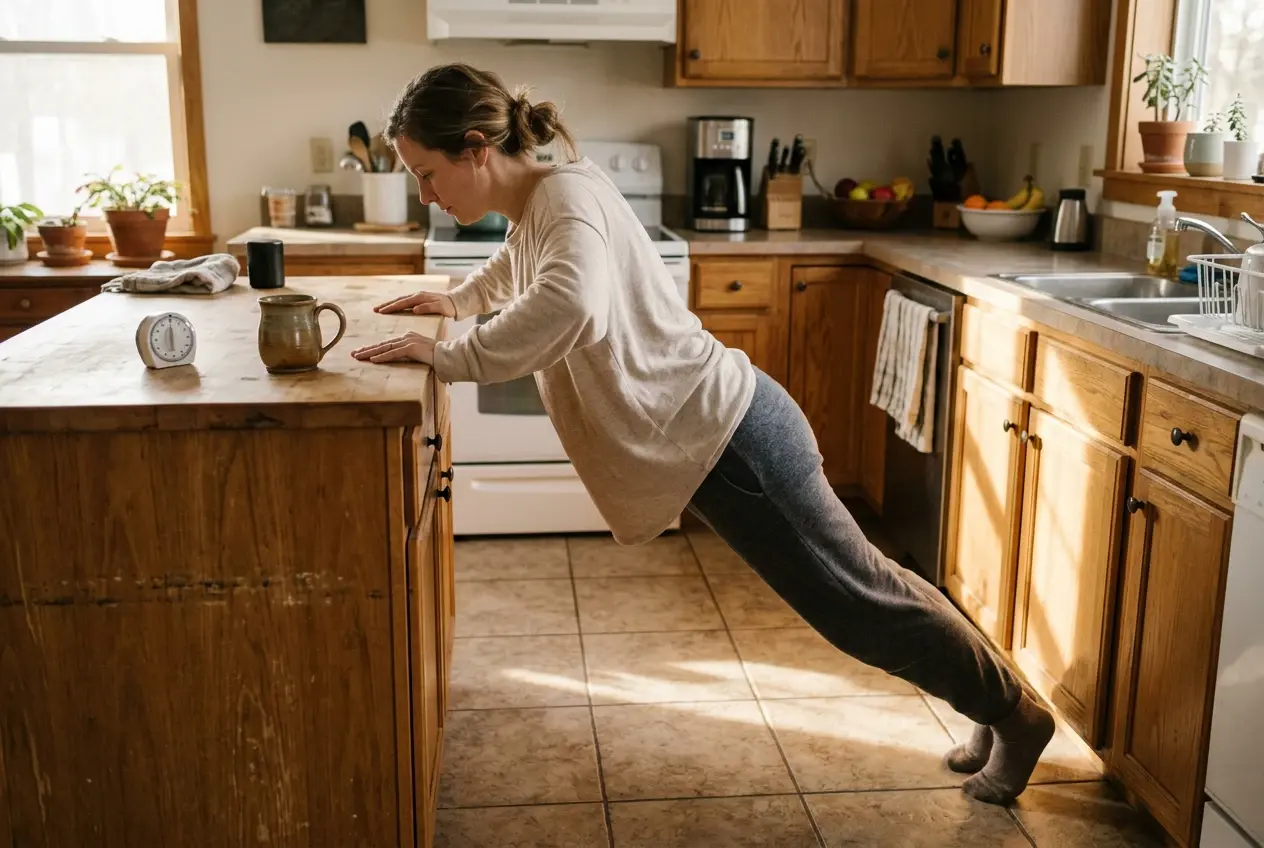
- Counter push-ups with your hands on the edge of the counter
- Marching in place or step-ups on the bottom stair
- Glute bridges on the floor or on a mat
- Standing side leg lifts, holding the counter for balance
- A few slow arm circles and shoulder rolls to finish
Pick two or three, and do a round or two until the time is up. You don’t need to be out of breath. The goal in the first few weeks is showing up, not working hard. Showing up is the habit, and the intensity can come later.
Three habit stacks to try: coffee brewing, kids eating, lunchbox packing
A habit stack uses this sentence: “After I do [anchor], I will do [small workout].” Writing it down in that form makes it specific enough to act on. Here are three to try.
Stack 1: coffee brewing
“After I press start on the coffee maker, I’ll do squats and counter push-ups until it finishes.”
Most coffee makers take several minutes, which covers your five. The coffee also gives you something to look forward to when you’re done. This one suits moms whose kids are still asleep or occupied for those first few minutes.
Stack 2: kids eating
“After I set down the cereal bowls, I’ll do my five minutes in the kitchen or the next room.”

Your kids are busy eating, and you can still see them. This works well with younger kids who like company. Some kids will want to join in, and that can be a fun way to get them moving too. March in place together, count squats out loud, or let them pick the next move. If they’d rather eat and ignore you, that’s fine as well.
Stack 3: lunchbox packing
“While the sandwiches are being made, I’ll do a set of calf raises or squats between steps.”
This one fits into the gaps. Pack the bread, do ten squats. Add the fruit, do ten calf raises. It breaks the five minutes into small pieces, and the workout is spread across a task you were already doing. It’s less tidy than the first two, but it works for mornings when you can’t stop for five straight minutes.
If your mornings don’t match any of these, use your own anchor. The method stays the same: one fixed moment, one small workout.
Set up the night before so your future self has no excuses
A lot of morning workouts fail before they begin, because the morning version of you has to make too many decisions. Take most of those decisions off her plate the evening before.
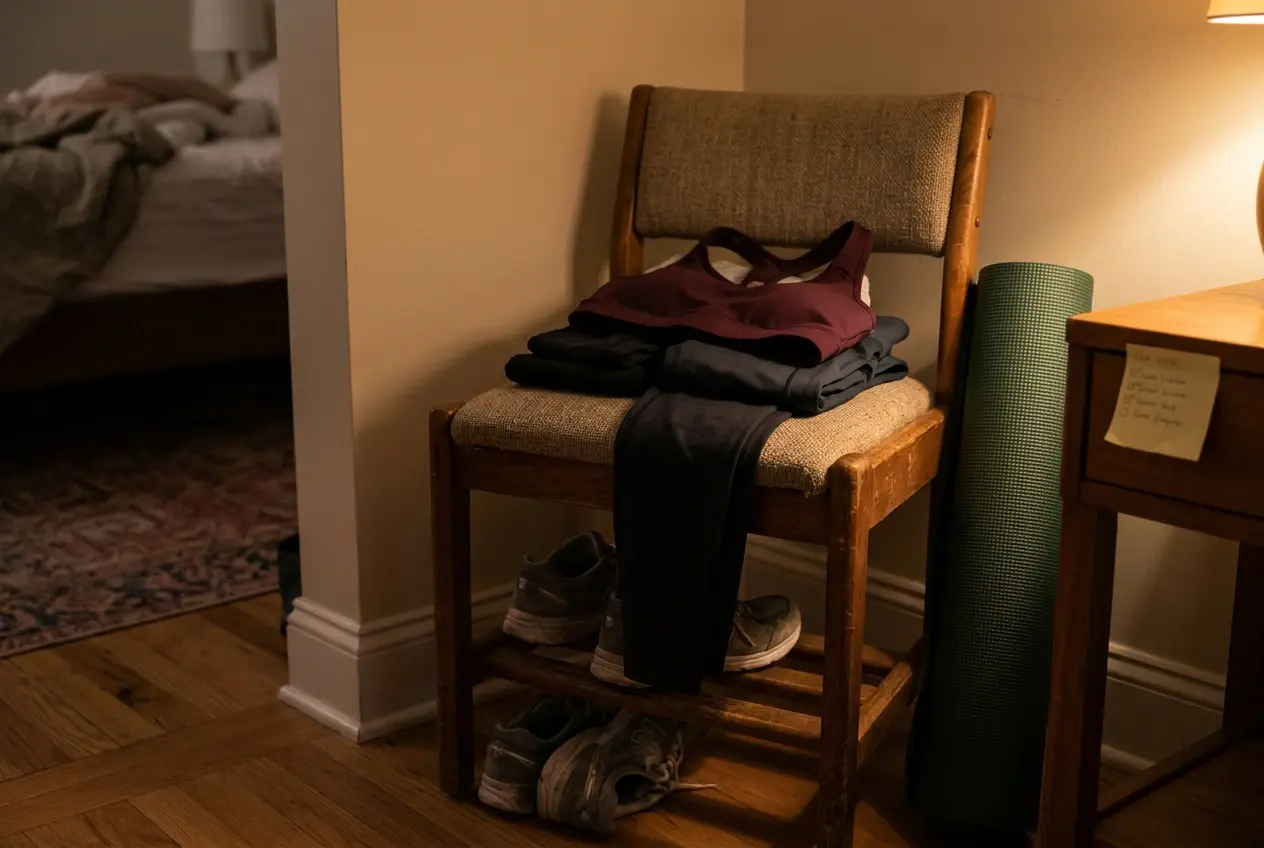
A few things to set up the night before:
- Clothes: Put your workout clothes on the chair, or sleep in something you can exercise in. Having to find a sports bra at 6:30 a.m. is enough to end the plan.
- Mat or space: If you use a mat, unroll it where you’ll use it, or leave it leaning against the wall in the kitchen. Clearing a small patch of floor takes seconds, but only if you don’t have to go looking for the mat.
- Your list of moves: Write the two or three exercises on a sticky note and stick it to the cabinet near your anchor. You won’t have to think about what to do.
- A simple breakfast plan: Decide what you’ll eat or what the kids will eat. Overnight oats, yogurt and fruit, or boiled eggs from earlier in the week mean one less thing to figure out when you’re short on time.
None of this takes more than a few minutes in the evening. It’s worth doing because it removes friction at the time of day when you have the least patience for it.
What to do when a kid wakes up early or the morning falls apart
Some mornings will go wrong. A kid wakes up early, someone is sick, or you overslept and the school bus is almost here. A plan for those days is part of the habit, because without one a bad morning turns into a skipped week.
Set up three levels ahead of time:
- Plan A: Your normal five minutes at your anchor.
- Plan B: One minute. Do ten squats or a short wall push-up set wherever you are. That’s the whole workout.
- Plan C: Move later in the day. Take a ten-minute walk after drop-off, or do your five minutes while dinner is cooking. Moving later still counts, and you didn’t lose the day.
The idea behind plan B is that you never fully skip. A one-minute workout on a hard morning keeps the routine alive and costs almost nothing. Plan C gives you permission to move the workout rather than drop it.
When a morning goes wrong, you don’t need to make up for it the next day with a longer session. Go back to plan A the next day and carry on.
How to tell it’s sticking and when to add more time
After a couple of weeks, you may notice that you do the workout without arguing with yourself. You reach for the mat when the coffee starts. You feel a little odd if you skip it. Those are signs the anchor is working.
Some other signs it’s sticking:
- You’ve done it on most mornings for two or three weeks in a row.
- It feels easy rather than like a chore.
- You find yourself doing a little more than five minutes without planning to.
Once that happens, add time slowly. Go from five minutes to seven or eight, or add one extra move. Stay at the new length for a week or two before changing it again. If a longer version feels like too much, go back to the shorter one. Nothing is lost.
When you’re ready for something beyond a few bodyweight moves, a gentle option is the 10-minute stretching routine for busy moms, which fits nicely as a slightly longer morning session. And if you’d like a little equipment such as bands or light weights, the home workout equipment picks for small spaces cover options that don’t take over your living room.
Easing in if you’re newly postpartum or restarting after a long break
If you’ve recently had a baby, or you’re coming back after a long break from exercise, the same approach applies with an even gentler start. Begin with a very short walk, some easy stretches, or a few slow bodyweight moves, and let your body set the pace.
Your doctor or midwife is the right person to ask about when it’s safe to begin exercising after birth, especially if you had a cesarean or any complications. Once you have the go-ahead, the postpartum fitness for beginners guide walks through a gentle restart.
Two minutes of movement at your anchor is a perfectly good beginning. You can build from there when it feels comfortable.
Try it for seven days
Pick one morning anchor, the coffee brewing, the cereal bowls, or the lunchbox line. Choose two or three easy moves, and do five minutes with that anchor for the next seven days. Set out your clothes the night before, and keep your plan B ready for the mornings that go sideways.
When the week is done, you’ll have a clear idea of whether the anchor works for you. If you want a next step that fits the same low-pressure approach, the free printable 30-Day Walking Plan for busy moms gives you an easy way to keep moving once your morning habit is in place.

Hi, I’m Monica, creator of NicaFitness. I’m passionate about helping busy moms stay active and healthy through simple fitness tips, quick workouts, and nutritious meal ideas. My mission is to make healthy living realistic and achievable for busy lifestyles.