If you’ve ever bought a piece of workout gear that now holds up a corner of the bedroom, this article is for you. Most “best home gym” lists assume a spare room and a free hour. A small apartment or a full house with a nap schedule needs different gear.
This list is built around those limits. Each of the five picks is judged on the real question: will you actually use it? I’ve also noted who can skip each one, because the right home workout equipment for small spaces is whatever you will pull out on a tired Tuesday.
Before you buy anything: the small-space test
Run every item through four questions before it goes in your cart.
- Does it fit in a closet, a bin, or under the couch? If it needs its own corner, it will end up as furniture.
- Does it work in a few feet of floor? You should be able to use it in the gap between the couch and the coffee table.
- Is it quiet? Nap time and early mornings are often your only windows. Clanging plates and thudding jumps can wake a child or annoy a neighbor downstairs.
- Can you start in under a minute? Every extra step, like assembling, adjusting, or untangling, is a reason to skip the workout.
An item that fails two or more of these is probably not for you right now, however good the reviews are. A small budget makes the test even more useful, because it keeps you from buying “just in case” gear.
Resistance bands: buy these first
If you buy only one thing, make it resistance bands. They weigh almost nothing, fold into a drawer, and make no noise at all. You can use them for legs, glutes, back, shoulders, and arms, so one small purchase covers a full-body workout.
There are two main types, and they suit different jobs:
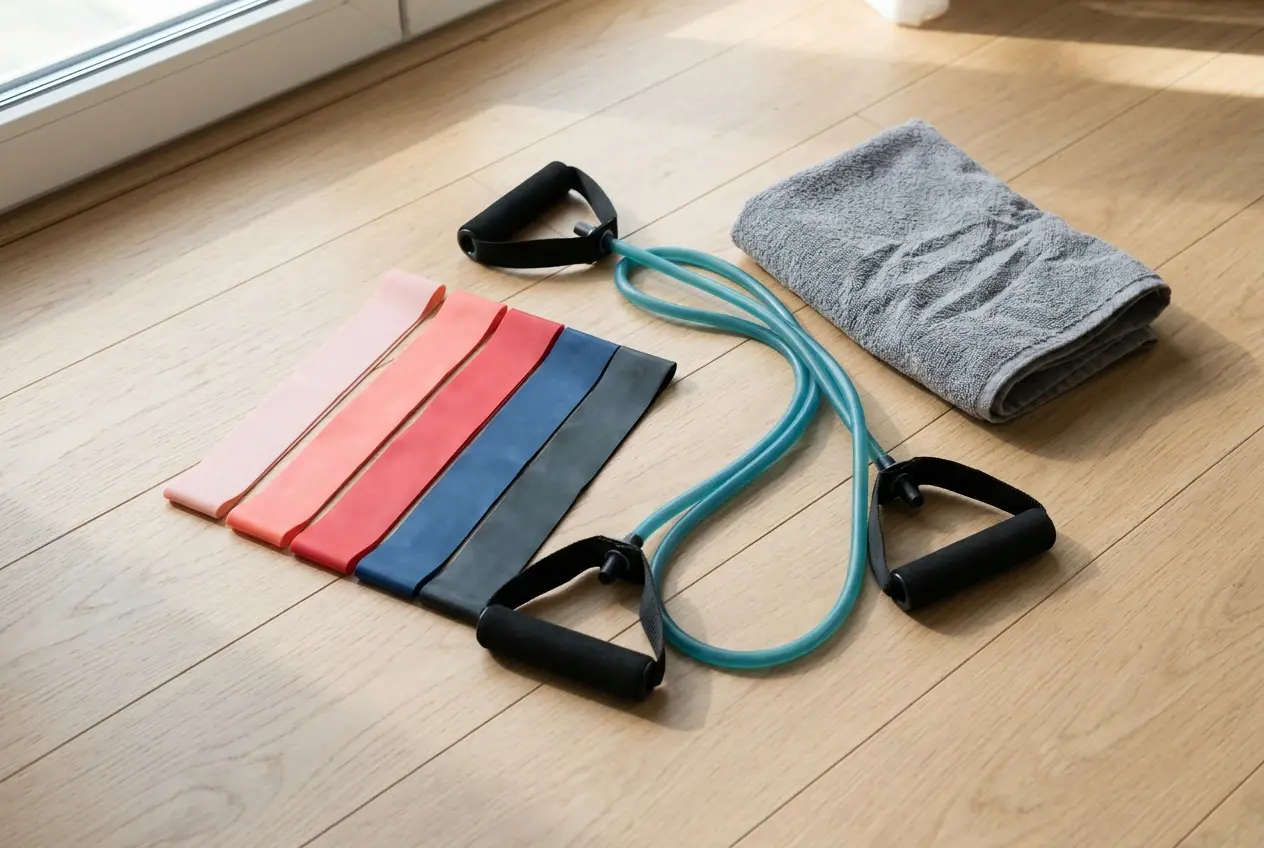
- Loop bands (mini bands) are short circles that go around your thighs or ankles. They are good for glute bridges, squats, lateral walks, and clamshells.
- Tube or long bands with handles work more like cable machines. They are good for rows, presses, and bicep curls, and many come with a door anchor.
Bands usually come in sets with different resistance levels. Buying a set gives you room to progress, since a light band works for shoulders while a heavier one suits legs. Check the product description for how the levels are labeled, because brands don’t all use the same system.
Who can skip them: Almost nobody, but if you already have a set of dumbbells you like, bands are a nice extra rather than a must-have. Also, bands can snap or wear out over time, so look them over for nicks and cracks before each use.
Adjustable or compact weights: strength without a rack
Bands build strength, but at some point many people want something heavier to lift. You don’t need a rack or a rack of dumbbells. There are a few compact options that suit a small home.
- Adjustable dumbbells let you change the weight with a dial or pin, so one pair replaces several. They take up about the space of a shoebox, but they cost more upfront than a single fixed pair.
- A single kettlebell is a good fit if you want one tool for swings, goblet squats, and carries. It stores easily in a closet corner.
- One or two fixed dumbbells in a weight you can use for most moves is the cheapest route. If you’re returning to exercise, a lighter pair is often enough for a while.
Think about noise as well. Setting metal weights down on a hard floor is loud. Lower them onto a mat, or use weights with a rubber or neoprene coating, if someone is sleeping nearby.
Who can skip them: If your goal is general fitness and you are happy with bands and bodyweight moves like squats, lunges, and push-ups, you can wait. Add weights when moves start to feel too easy even after you’ve added reps and slowed them down.
A good mat: your workout spot in 10 seconds
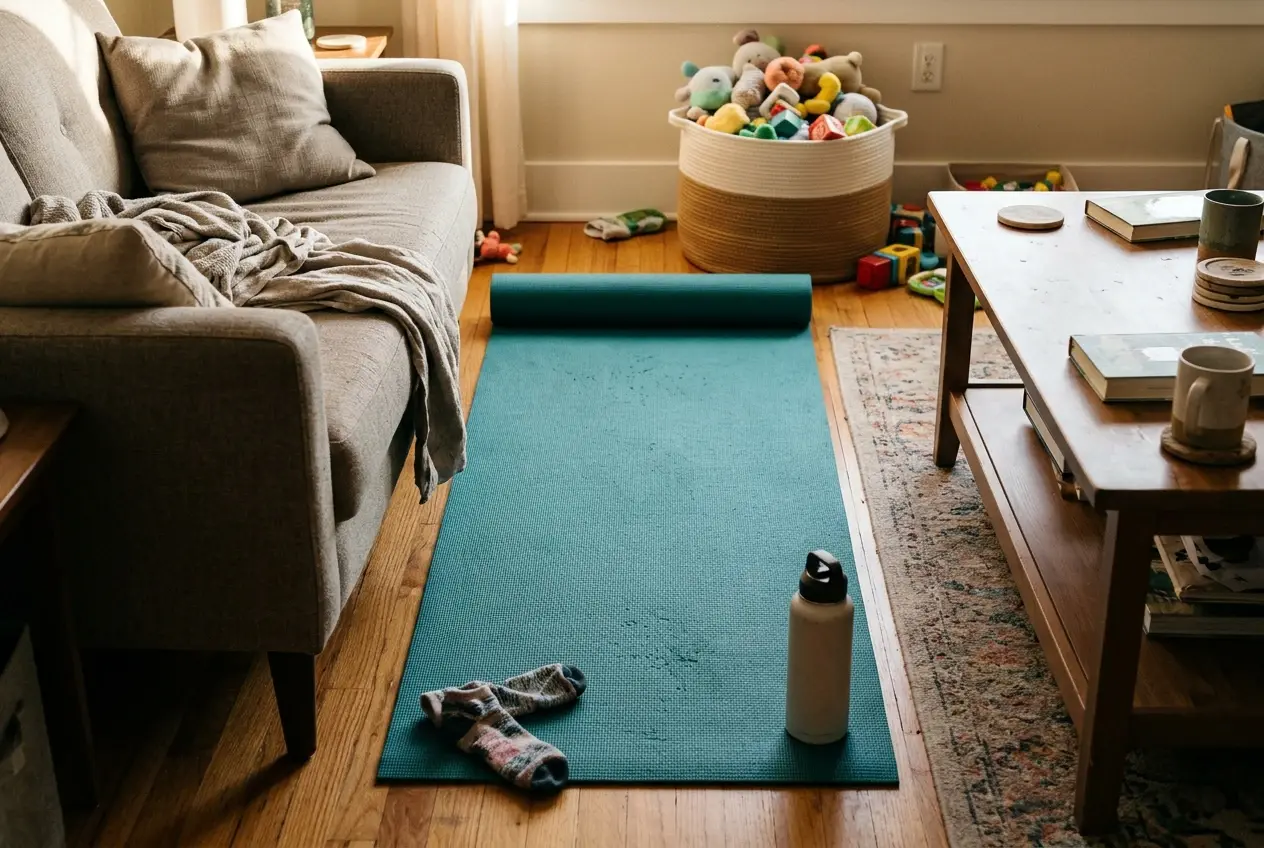
A mat sounds boring, but it does a surprising amount of work. Unrolling it tells your brain that it’s time to exercise, and it marks out a small area where you can work without bumping into furniture. It also cushions your knees, wrists, and spine for floor work, and it dampens noise.
A few things to look for:
- Thickness. A thicker mat is gentler on knees and hips for floor moves. A very thick, soft mat can feel wobbly for standing moves like lunges, so pick based on what you’ll do most.
- Grip. A textured surface keeps your hands and feet from sliding, which matters on hardwood or tile.
- Size and storage. Check the dimensions against your floor space. A mat that rolls up or folds flat can slide behind a door or under a bed.
If you’re newer to exercise or easing back in after having a baby, a mat is a very good first purchase. Our guide to postpartum fitness for beginners covers gentle ways to restart, and it’s always wise to check with your doctor before starting a new routine.
Who can skip it: If you have a carpeted floor and mostly plan to do standing exercises, a mat is optional. A folded towel can work for the occasional floor move.
A jump rope or low-impact cardio option for tiny spaces and sleeping kids
Cardio is where small spaces get tricky. A jump rope is cheap, folds into a pocket, and gives a lot of heart-rate work in a short time. It also needs enough ceiling height and floor space to swing, and it can be loud. Landing on a hard floor above a neighbor is a good way to get a note on your door.
Before you buy a rope, check these:
- Ceiling height. You need clearance above your head for the rope to pass.
- Floor type. Jump on a mat or a forgiving surface, not tile over a downstairs unit.
- Joints and recovery. Jumping is high impact. If you’re recovering from childbirth or have knee, ankle, or pelvic floor concerns, ask a healthcare provider first.
If a rope doesn’t fit your home or your body, you can get cardio without jumping at all:
- Marching in place with high knees
- Step-outs and side steps
- Shadow boxing
- Squat-to-reach
- Fast bodyweight circuits with short rests
These need no equipment and almost no floor space, and you can do them in socks while a baby naps. A pair of supportive shoes will help if you do more of them, and a mat takes the sting out of landing.
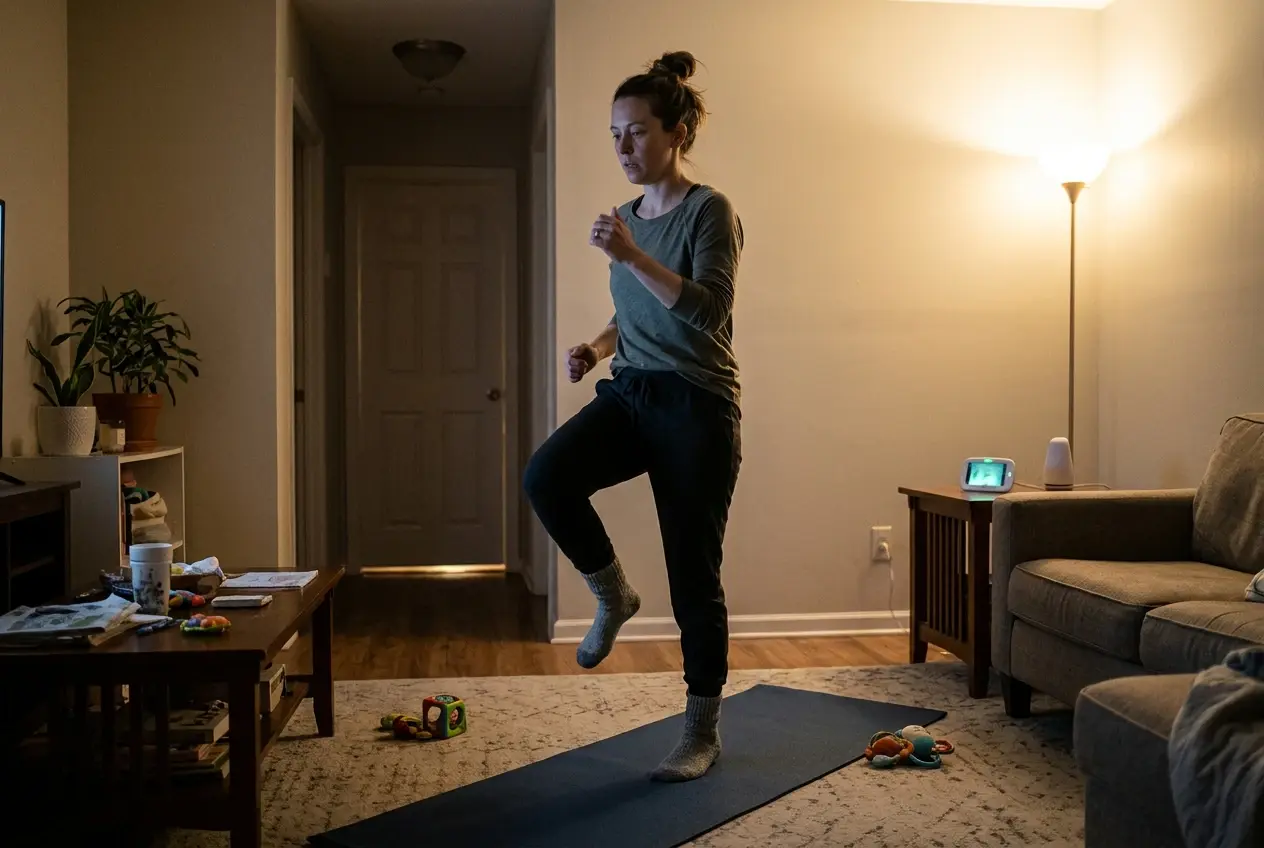
Who can skip the rope: Anyone with low ceilings, downstairs neighbors, or joints that don’t love impact. Low-impact moves give you a real workout without those problems.
A doorway or suspension trainer: who it’s for and who can skip it
A doorway anchor or suspension trainer is a set of straps you hang from a door or a sturdy overhead point. You use your body weight against the straps for rows, push-ups, assisted squats, and core work. It folds down to the size of a small pouch.
It’s a great fit if you:
- Want pulling moves like rows, which are hard to do with bodyweight alone
- Have a solid door or anchor point you can use safely
- Like variety and want something more advanced than bands
Safety is the main issue here. The anchor has to be strong enough and rated for use, and the door has to be the right type and shut and secured the way the manufacturer says. Read the instructions and weight limits before the first use, and test the setup gently before you lean your full weight on it.
Who can skip it: Most beginners. If you already have bands with handles, you can do rows and presses with those and save the money. It’s also not the best choice if your doors are lightweight or open the wrong way, or if the setup would feel like a chore. Buy it later if you find yourself wanting more pulling exercises.
Where to store it all and how to build a 15-minute routine
Storage decides whether any of this gets used. Keep everything in one place so you can grab it without hunting.
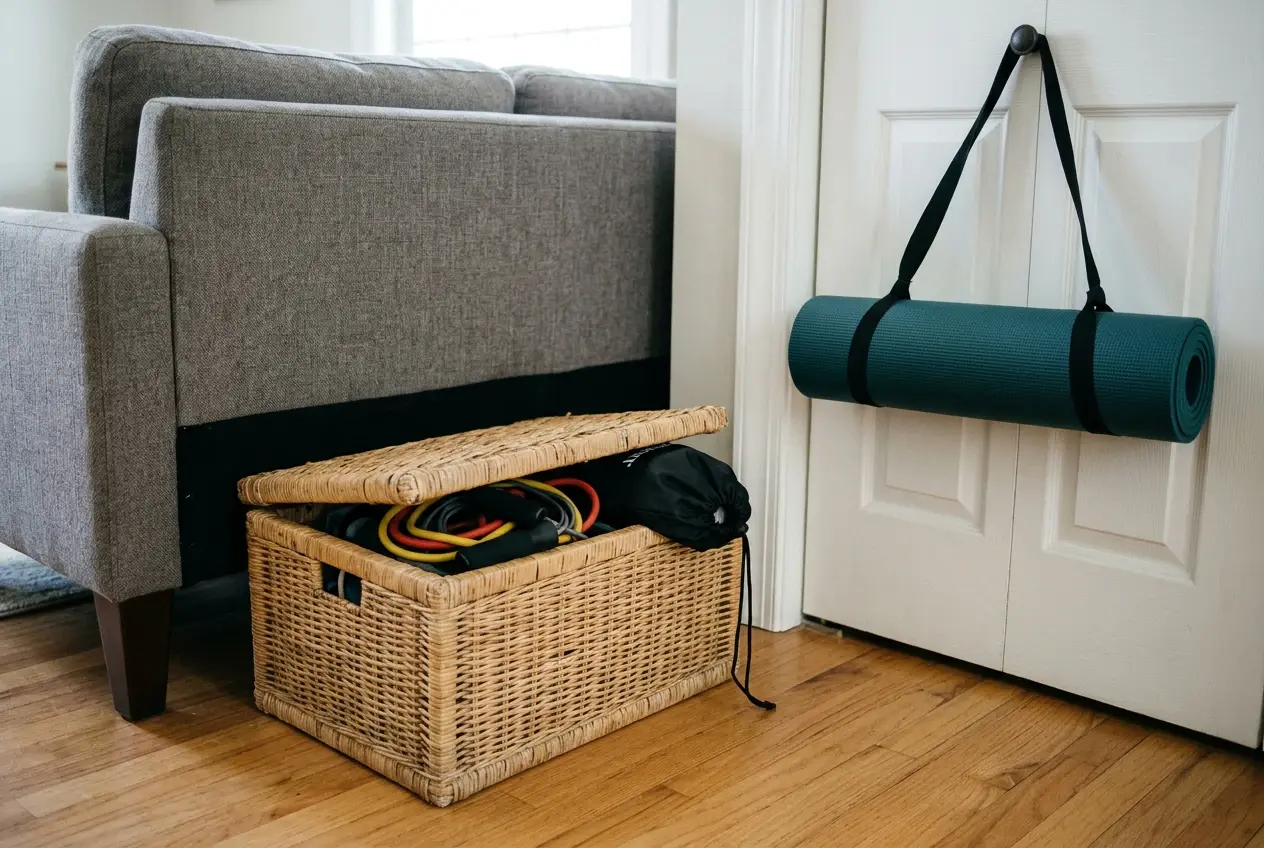
- A small bin or basket with a lid fits bands, a rope, and straps. Slide it under a couch, bed, or console table.
- A hook on the back of a door or closet holds a rolled mat or a set of bands.
- A spot near where you’ll work out. If the bin is in the bedroom and you work out in the living room, you’re adding friction. Put it close.
Leave the mat somewhere you’ll see it. If it’s visible, you’re more likely to use it.
A simple 15-minute routine
Here’s a routine that uses what you have. You can do it with bands alone, or add a weight if you have one.
- Warm up (2 minutes). March in place, roll your shoulders, and do some easy bodyweight squats.
- Circuit (10 minutes). Do each move for 40 seconds, rest for 20 seconds, and go through the list twice:
- Squats (with a band above the knees if you have one)
- Band rows or dumbbell rows
- Glute bridges on the mat
- Push-ups, on your knees or against a wall or counter if needed
- Marching or low-impact cardio
- Cool down (3 minutes). Stretch your legs, chest, and back. If you’d like a longer one, try our 10-minute stretching routine for busy moms.
If 15 minutes is too much on a given day, do the circuit once. Ten minutes still counts. If you want help fitting workouts into the rest of your week, our realistic weekly wellness routine for busy moms can help you decide which days to prioritize.
Start small this week
You don’t need all five items. Pick one that passes the small-space test, such as a set of resistance bands or a mat, and use it for a 10-minute session this week. Do it during nap time or after the kids are in bed, whichever is easiest to protect.
If you’d like more help, join the NicaFitness email list. You’ll get new printables and simple, mom-friendly fitness ideas that fit into a busy day.

Hi, I’m Monica, creator of NicaFitness. I’m passionate about helping busy moms stay active and healthy through simple fitness tips, quick workouts, and nutritious meal ideas. My mission is to make healthy living realistic and achievable for busy lifestyles.