
If you have 20 minutes, a floor, and a phone timer, you have what you need for a workout today. This post gives you three 20 minute HIIT workouts for busy moms, each built for a different kind of day: a quiet nap-time window, kids playing nearby, and a day when your energy is low.

Each routine lists the exact work and rest times, a beginner version, and a harder version. Pick the one that matches your day and start the timer.
Why 20 minutes of HIIT can fit into a mom’s day
HIIT stands for high-intensity interval training. You work hard for a short stretch, rest briefly, and repeat. Because the effort comes in small chunks, the workout is easy to start and easy to pause.
That fits a mom’s day well. A nap, a quiet half hour while the kids play, or the window before the next school pickup is often all the time you get. A short session you can finish is worth more than a long one you keep putting off.
The rest periods also give you a built-in moment to check on a toddler, grab water, or catch your breath. Beginners can set the pace by how hard they push during the work intervals.
What you need (nothing, but here’s what makes it easier)
Every move in this post uses your body weight. You do not need dumbbells, bands, or a gym membership.
These small things make the session smoother:

- A timer. Your phone’s interval timer works, and so does a simple stopwatch. Set it before you start so you are not checking the clock mid-move.
- Supportive sneakers. Jumping and quick side steps are easier on your feet and knees in real workout shoes than in socks or slippers.
- A mat or a folded towel. This makes floor moves like planks and bridges more comfortable.
- A sturdy counter, couch, or chair. Several moves have a version where you press your hands against something stable.
- Water nearby. You will want it by the second round.
If you decide later that you want to add equipment, I put together a list of home workout equipment for small spaces that fits in a closet or under a bed. It is optional, and these routines work without it.
How a 20-minute HIIT session is built: warm-up, rounds, cool-down
Every routine below follows the same layout, so you only need to learn it once.
- Warm-up: 3 minutes.
- Work rounds: 14 minutes.
- Cool-down: 3 minutes.
The warm-up raises your heart rate gradually and loosens your joints. Do each of these for one minute:
- March in place, swinging your arms.
- Arm circles, then leg swings holding a wall or chair if you need balance.
- Easy bodyweight squats mixed with a few slow jumping jacks.
The work rounds are where the intervals happen. On a scale of 1 to 10, the work periods should feel like a 7 or 8. You should be breathing hard and able to say only a word or two. The rest periods are for slowing your breathing, not for scrolling your phone, so keep standing and shake out your arms.
The cool-down brings your heart rate back down. Walk slowly for one minute, then spend two minutes stretching your quads, hamstrings, and chest. If you want a longer option, the 10-minute stretching routine for busy moms pairs well with any of these.
Routine 1: The nap-time burner
Best for: a quiet window when you can focus and push hard.
Timing: 40 seconds of work, 20 seconds of rest. Seven moves, then repeat the whole circuit once. That is 7 minutes per round and 14 minutes total.
The moves:
- Squat jumps
- Reverse lunges, alternating legs
- Mountain climbers
- Push-ups
- High knees
- Plank shoulder taps
- Burpees
Beginner version: Swap squat jumps for regular squats. Do the push-ups with your hands on a counter or your knees on the mat. Replace burpees with a step-back burpee, where you step one foot back at a time instead of jumping. Do high knees as a fast march.
Harder version: Add a tuck jump to the top of each burpee. Slow the push-ups down so each rep takes three seconds. Take only 10 seconds of rest instead of 20 and use the extra time for more work, making the circuit 45 seconds on and 15 seconds off.
Quiet option: If a baby is sleeping nearby or you have neighbors below, use the beginner versions of the jumping moves. They are low impact and much quieter, and they still raise your heart rate when you move fast.
Routine 2: The kids-are-nearby circuit
Best for: days when the kids are playing in the same room and you will probably get interrupted.

Timing: 30 seconds of work, 30 seconds of rest. Seven moves, then repeat once. The 30-second rest is long on purpose. It gives you room to answer a question, hand over a snack, or fix a toy without losing the workout. If a kid needs you for longer, pause the timer and pick up where you left off.
The moves:
- Jumping jacks
- Sumo squat with a calf raise at the top
- Skater hops (side to side, landing on one foot)
- Incline push-ups with your hands on the couch
- Glute bridge marches (lie on your back, lift your hips, and alternate lifting each foot)
- Plank jacks
- Fast feet (quick, small steps in place)
Beginner version: Do the jumping jacks as step jacks, tapping one foot out at a time. Do skaters as slow side steps without the hop. Do plank jacks as step-back plank steps, and hold a normal bridge instead of marching.
Harder version: Lower the couch push-ups to a mat. Add a pulse at the bottom of each sumo squat. Make the skater hops wider and faster.
A tip for working with kids around: Check the floor for toys before you start, since you will be moving quickly and landing on one foot. Older kids often want to copy you, which turns the circuit into a game. Younger ones may climb on you during bridges and planks, so those moves are good ones to skip or modify on a busy day. Replace them with extra jumping jacks or squats.
Routine 3: The low-energy day version
If you slept badly or feel run down, this routine keeps the structure and lowers the demand. It is still HIIT, since you are alternating effort with rest, but the effort is closer to a 6 or 7 out of 10 and the rest is longer.
Timing: 20 seconds of work, 40 seconds of rest. Four moves, one per minute, repeated for three rounds. Take a full extra minute of easy walking between rounds. That is 12 minutes of intervals plus 2 minutes of rest, which makes 14.
The moves:
- Fast march with punches (march quickly and punch forward in time with your steps)
- Chair squats (sit down and stand back up, tapping the chair lightly)
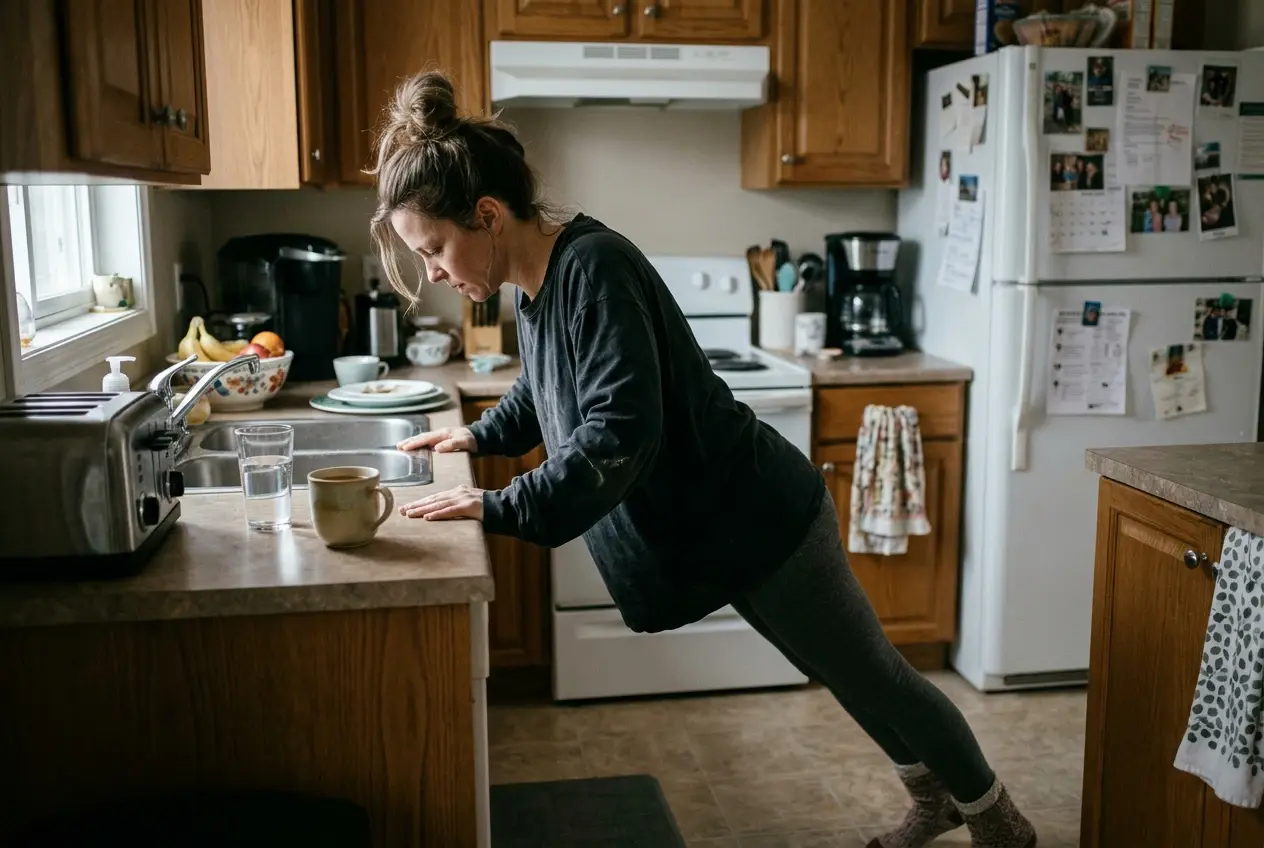
- Counter push-ups (hands on the counter, body in a straight line)
- Counter mountain climbers (hands on the counter, driving one knee at a time toward your chest)
Beginner version: Make the counter push-ups wall push-ups, with your hands on the wall and your feet a step back. Do the counter climbers as slow knee lifts.
Harder version: Shorten the rest to 30 seconds and the work to 30 seconds. Switch the chair squats to regular bodyweight squats without the chair.
A low-energy day is often a good moment to look at the basics too. If you are tired on most days, the simple tips for increasing daily energy levels may help more than another workout.
How to make it easier or harder, and when to check with your doctor first
You can adjust any of these routines with a few simple changes.
To make it easier:
- Replace jumping with stepping.
- Lift your hands onto a counter or couch for push-ups and planks.
- Shorten the work interval by 10 seconds or lengthen the rest.
- Do one round instead of two, and add the second round next week.
To make it harder:
- Add 5 to 10 seconds to each work interval.
- Cut the rest by 5 to 10 seconds.
- Slow the lowering part of squats and push-ups.
- Add a jump to moves that are already stable and controlled.
HIIT asks more of your body than a casual walk, so it is worth talking to your doctor before you begin if any of these apply to you:
- You are pregnant.
- You are recovering from a recent birth or a C-section.
- You have a heart condition, high blood pressure, or joint or back problems.
- You have not exercised in a long time and feel unsure about it.
If you are in the postpartum stage, postpartum fitness for beginners covers a gentler way back into exercise. During any workout, stop if you feel chest pain, dizziness, or pain in a joint. Hard breathing is normal during intervals, but those symptoms are different and need attention.
How to fit it into your week without burning out
HIIT is demanding, and your body needs recovery time between sessions. Two or three sessions a week, on non-consecutive days, is a sensible place to start. A schedule might look like this:
- Monday: Routine 1 during nap-time or while the house is quiet.
- Wednesday: Routine 2 on an afternoon when the kids are playing nearby.
- Friday or Saturday: Routine 3, or a repeat of whichever routine you liked best.
On the days in between, light movement helps without adding more intensity. A walk is plenty, and the 30-day walking plan for busy moms is a free printable that fits around these sessions.
Use these as a guide for choosing the right routine on the day:
- If you have a quiet, uninterrupted window, choose Routine 1.
- If you are likely to be interrupted, choose Routine 2.
- If your energy is low, choose Routine 3.
- If none of them feel possible, do just the warm-up and cool-down. Six minutes of movement still counts.
Repeat the same routine for a couple of weeks before you change anything. Doing the moves a few times lets you learn the order, and you will notice that the work intervals feel easier. When they do, make the routine harder using the options above.
Keep going with short workouts made for real life
If these routines fit your schedule, join the NicaFitness email list. You will get more short, realistic workouts and routines designed for busy moms, sent straight to your inbox.
You can also save these three routines to Pinterest so you can find them on the next day you have 20 minutes to spare.

Hi, I’m Monica, creator of NicaFitness. I’m passionate about helping busy moms stay active and healthy through simple fitness tips, quick workouts, and nutritious meal ideas. My mission is to make healthy living realistic and achievable for busy lifestyles.